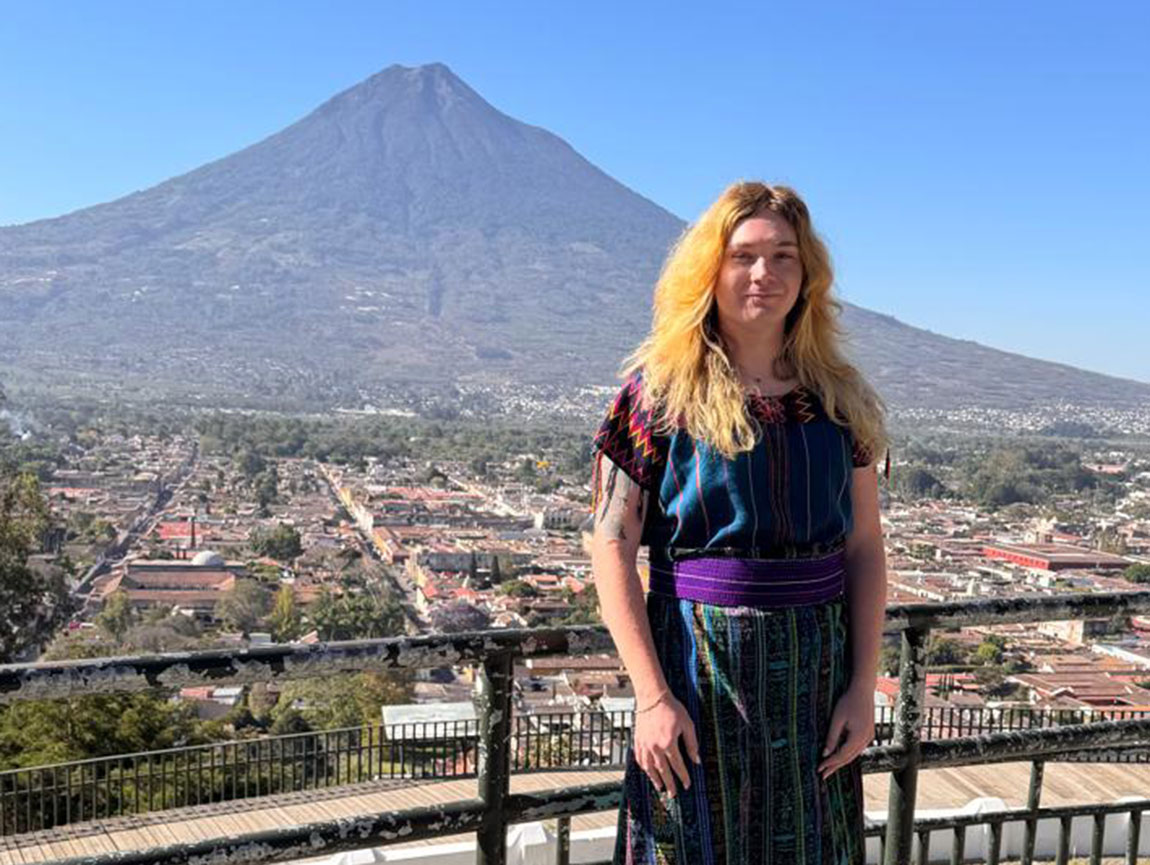
La Antigua was founded in 1524 and was the capital of Central America until it was abandoned in 1773. It is a city of cobblestone streets, Spanish-style buildings, and views of volcanoes just outside the windows.
In the 1970s, the tourism industry discovered Antigua and it became a destination spot.
“We are looking for balance between economic development and historic preservation,” Bell said. “It’s an ongoing effort, working with local Guatemalans so that the city maintains its character.”
Her preservation efforts extend beyond tourism. When she served as Director of Public Information at the National Council for the Protection of La Antigua Guatemala (Consejo Nacional Para la Proteccion de la La Antigue Guatemala in Spanish) from 1978 to 1987, Bell designed and directed the largest preservation educational program in Central America.
Through Bell’s work, many of Antigua’s crumbling monuments were restored and stabilized. They implemented housing permits and restored works of colonial art.
To prevent future decay, they developed educational and cultural programs to raise awareness of the need to preserve the colonial capital.
During Bell’s directorship, Antigua became a cultural UNESCO World Heritage Site.
Although the paperwork was already submitted before she took over as director, her work preserving the city has maintained the World Heritage Site status, which can be revoked.
She wrote and published “Antigua Guatemala: the City and its Heritage,” which came out of her historical preservation research. She wrote three bilingual coloring books about the city and its culture to give children a fun way to learn about the city.
Currently, urban expansion is the most pressing problem in Antigua.
“We can’t suffocate the historical center of the city,” Bell said.
She works with planning groups in the city to explain what works, what doesn’t and why. Although the city has added restaurants, hotels, and art galleries to the ancient cathedrals and churches, it has been done in an attractive manner, according to Bell.
There are no skyscrapers obscuring the city’s horizon. Traffic regulations encourage pedestrian travel. Old colonial homes have been converted into bed and breakfasts.
“It’s been tastefully done,” Bell said. “We want to maintain the colonial quality but also make it comfortable for tourists.”
“It’s a feeling. It’s hard to capture in photograph, because in the photographs you see colonial buildings or walls. It’s unique, it’s friendly, it’s a community. People are always welcome here. We make them feel welcome. You can read about the architecture in books but you have to come here to get the feeling. It’s comfortable.”