Guest post by Andrea Holbrook
I am somewhat shy about admitting that I had never been to see the monarch butterfly overwintering phenomenon myself. Holbrook Travel has been offering this program since 2017 with great success and it began to feel as if I were one of the few left in the office who had not been! Not only was I unfamiliar with the butterfly reserves but I had not yet visited Mexico City, a place whose reputation held a fascination for me, as it is known as one of the most populated cities on earth and yet now known as a place where people flock for culture, art, food, and more. The chance to experience the phenomenon with Dr. Akito Kawahara, the Director and Curator at the McGuire Center for Lepidoptera and Biodiversity at the Florida Museum of Natural History (my hometown natural history museum), was something I did not want to miss.
The trip, which took place in February, was such a wonderful experience on so many levels. Before leaving, I was in-between projects and almost decided to postpone it. Am I ever glad that I made the decision to go! I was reminded of the power of this kind of travel – but more on that later.
The surprise of Mexico City
Our program began in Mexico City, a dazzling experience in itself. Flying in with a view of the Popocatépetl Volcano with a plume of smoke visible on the horizon above Mexico City was a great introduction to this most vibrant and dynamic capital.
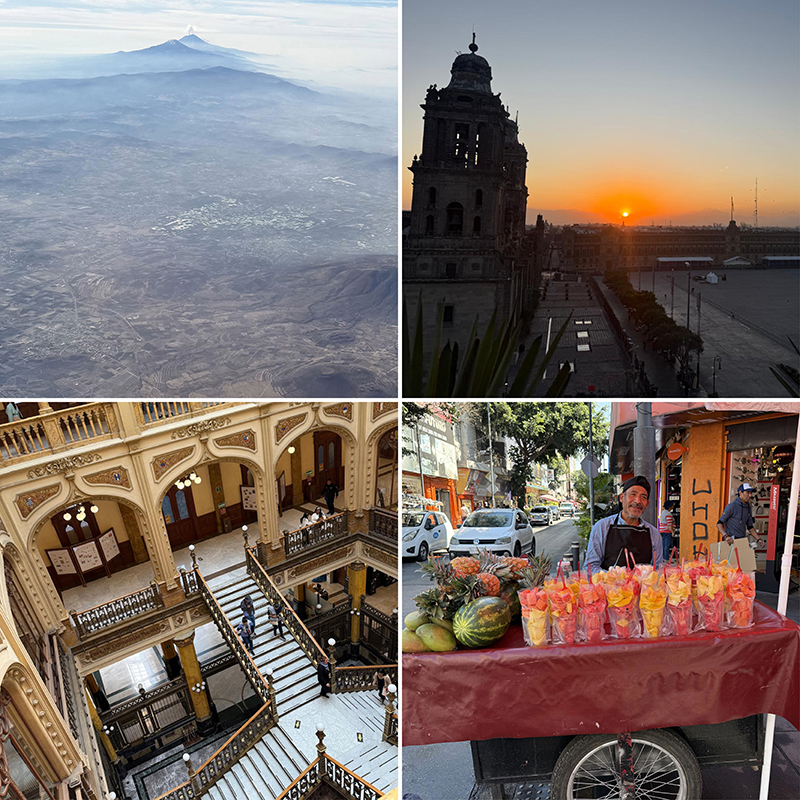
1. Popocatépetl Volcano, 43 miles southeast of Mexico City, with its smoky plume visible 2. Sunrise over the Plaza de la Constitución from the rooftop restaurant of the Zócalo Central Hotel; photo by Arturo Morales 3. View of the internal stairway of the Palacio Postal 4. Street vendor selling fresh fruit
The Zócalo, where our program begins, is in the heart of the city. From there, we explored the amazing Aztec ruins of the Templo Mayor and the Metropolitan Cathedral on the Plaza of the Constitution. Since I arrived a day early, I was able to visit a number of additional amazing sites all within walking distance of our accommodation. The Palacio Postal, which is literally a post office built in the first decade of the 1900s, took my breath away. Also within walking distance was the Palace of Fine Arts, a stunning example of Art Nouveau, Neoclassical, and Art Deco architecture. Inside we were able to see the murals of Diego Rivera, David Siqueiros, and other Mexican artists. The pieces seemed to jump out off of the walls. We enjoyed strolling the bustling streets and seeing the hundreds of small, busy stores – each with a specialty – filled with local shoppers.
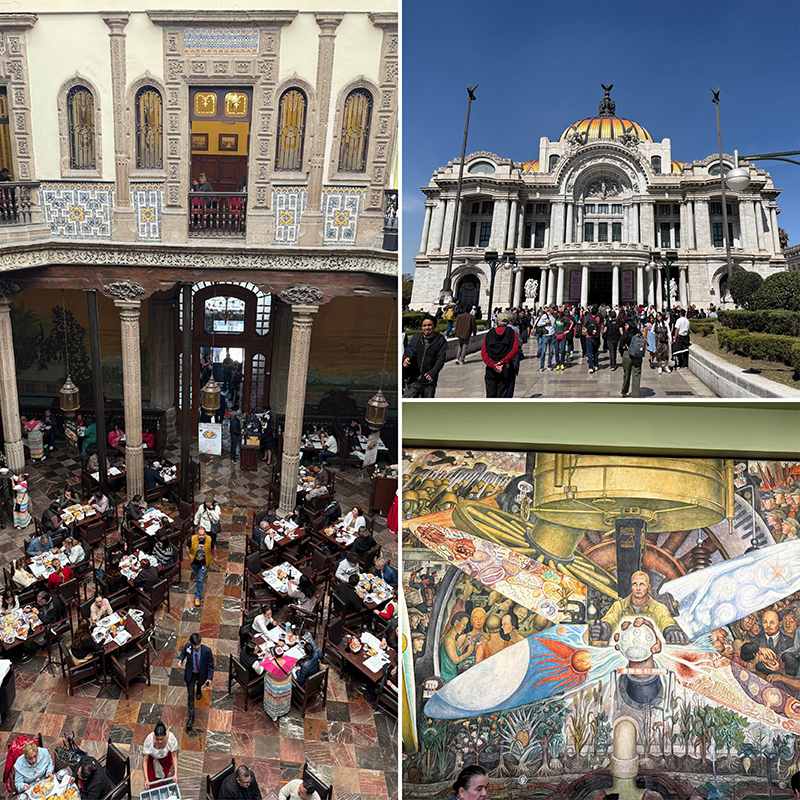
1. Sanborns in the Casa de los Azulejos 2. Palacio de Bellas Artes (Palace of Fine Arts) exterior 3. “Man, Controller of the Universe" mural by Diego Rivera, located in the Palacio de Bellas Artes in Mexico City
I saw restaurants like Sanborns, ensconced within one of the most beautiful buildings, known as the Tile House or the Casa de los Azulejos, where I imagined myself enjoying a Sunday morning coffee with a friend and taking the scene all in.
While I don’t think I had ever seen so many people in so many different spaces, I was very surprised with the relative sense of security I felt on the streets, as well as the relative cleanliness despite the enormous challenges within a metropolitan area of more than 20 million people. Mexico City is a place to which I would like to return and explore.
The experience in the sanctuary
The first reserve we visited within the Monarch Butterfly Biosphere Reserve was the Sierra Chincua Reserve. It was a partly cloudy day and I decided to hike both ways instead of riding by horseback. I was pleased that the 10,000 feet elevation did not overwhelm me. Our walk in the reserve lasted about half an hour before we reached the main clusters of the monarchs on the oyamel fir trees. There, at some distance from us and up in the trees, the butterflies were amassed so thickly that they were literally weighing down the boughs of the trees….many trees actually….all drooping with layers upon layers of butterflies all folded up. That was amazing to see! We stood there for a good while just taking it all in with our binoculars and cameras. This section of the trail was steeper and less even than most of the previous areas and there were other visitors there in addition to our group, but everyone was quiet and respectful in the presence of this spectacle.
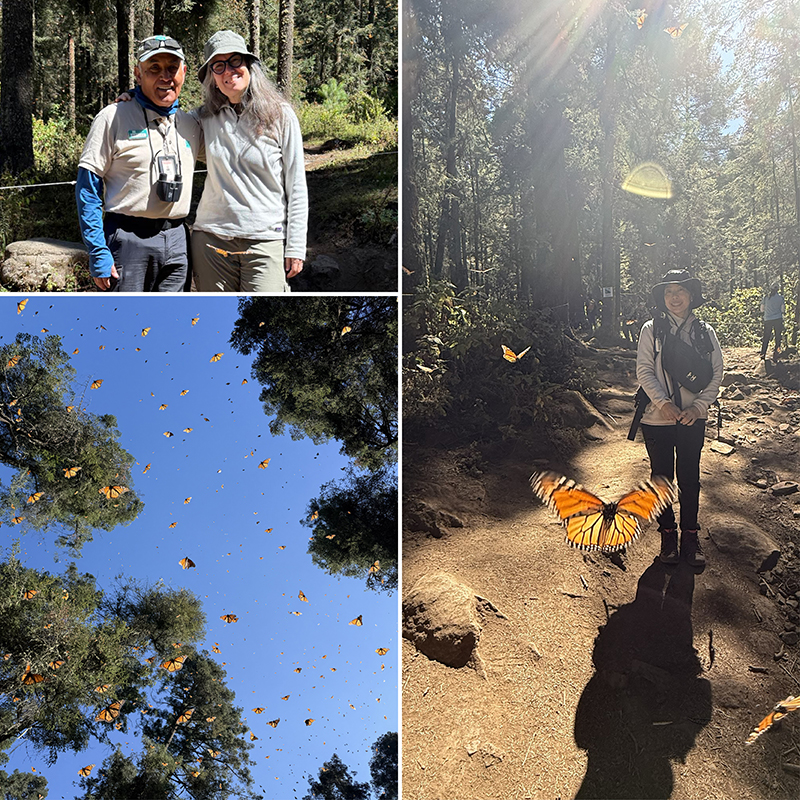
1. Me with Arturo Morales in the reserve 2. Looking up at the sky in El Rosario Reserve 3. Sarry Nagai, Jo Nagai’s mother, in Sierra del Rosario Reserve (I love the magic quality of this picture!)
One of the things that amazed me to learn from Dr. Kawahara is that scientists still don’t really understand why the monarchs select these particular forests for their overwintering. Why these trees, in this area? These trees, Abies religiosa, locally known as oyamel trees in the native Nahuatl language, are not used by the butterflies as a food source. Nor do the monarchs use these particular trees for any specific purpose that we know of, other than overwintering in this unique forested area. In a way, it’s thrilling to learn that so many important questions remain about the monarchs. It means we still have work to do facilitating journeys like this one together with the Florida Museum of Natural History.
Within the Sierra Chincua Reserve, we had a "forest-to-table" lunch with a young leader in the Sierra Chincua community named Yadira Ambrocio. Her restaurant is called Milpa de Hongos, which translates to "mushroom patch." The lunch was light, out-of-the-ordinary, and delicious. We had morel soup with the morel mushrooms that her grandmother had taught her to harvest and use. Then we were served corn tlacoyos (a flattened corn dough stuffed with squash blossoms) with quelites (wild edible herbs), freshly harvested in the community. For dessert, we had passionfruit on the shell.
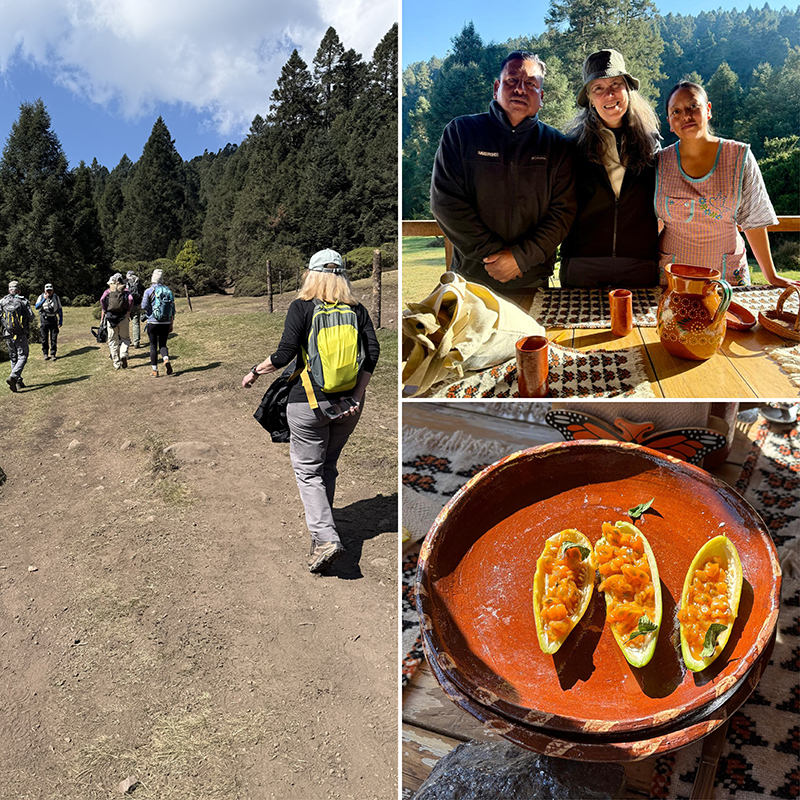
1. Walking into the Sierra Chincua Reserve 2. From left-to-right: Javier Ambrocio González, me, and Yadira Ambrosio at Yadira’s restaurant, Milpa de Hongos 3. Passionfruit dessert at the Milpa de Hongos, the unforgettable forest-to-table restaurant at Sierra Chincua
Beyond the delicious flavors, Yadira’s explanation of her goals in working with agriculture and food imbued the meal with meaning. Yadira is doing anthropological research to learn which crops and plants were traditionally grown and used for generations by local women in Sierra Chincua. In many cases, she incorporates non-commercially grown products into her menus such as the morels that grow in the forest. She is working to incorporate that knowledge into her understanding of which agricultural products can be compatibly grown within the immediate area and within the ecosystem where the oyamel forest thrives, minimizing the need to import foods from other areas. Additionally, she leads a women’s cooperative restaurant with the goal of putting everything she's learning into practice as social enterprise focused on feminist ideas – sustainability, economic independence, community, and cultural heritage. Yadira says her restaurant is "a small space in which to cook up encounters with life."
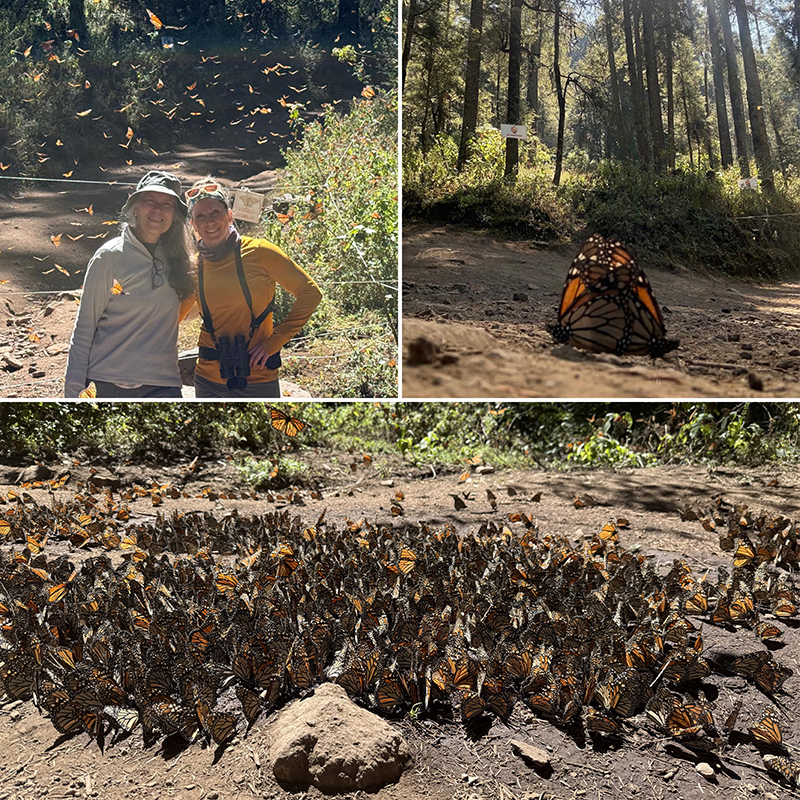
1. In the Monarch Reserve 2. Close-up of monarch butterflies; photo by Arturo Morales 3. Monarchs puddling at El Rosario Reserve
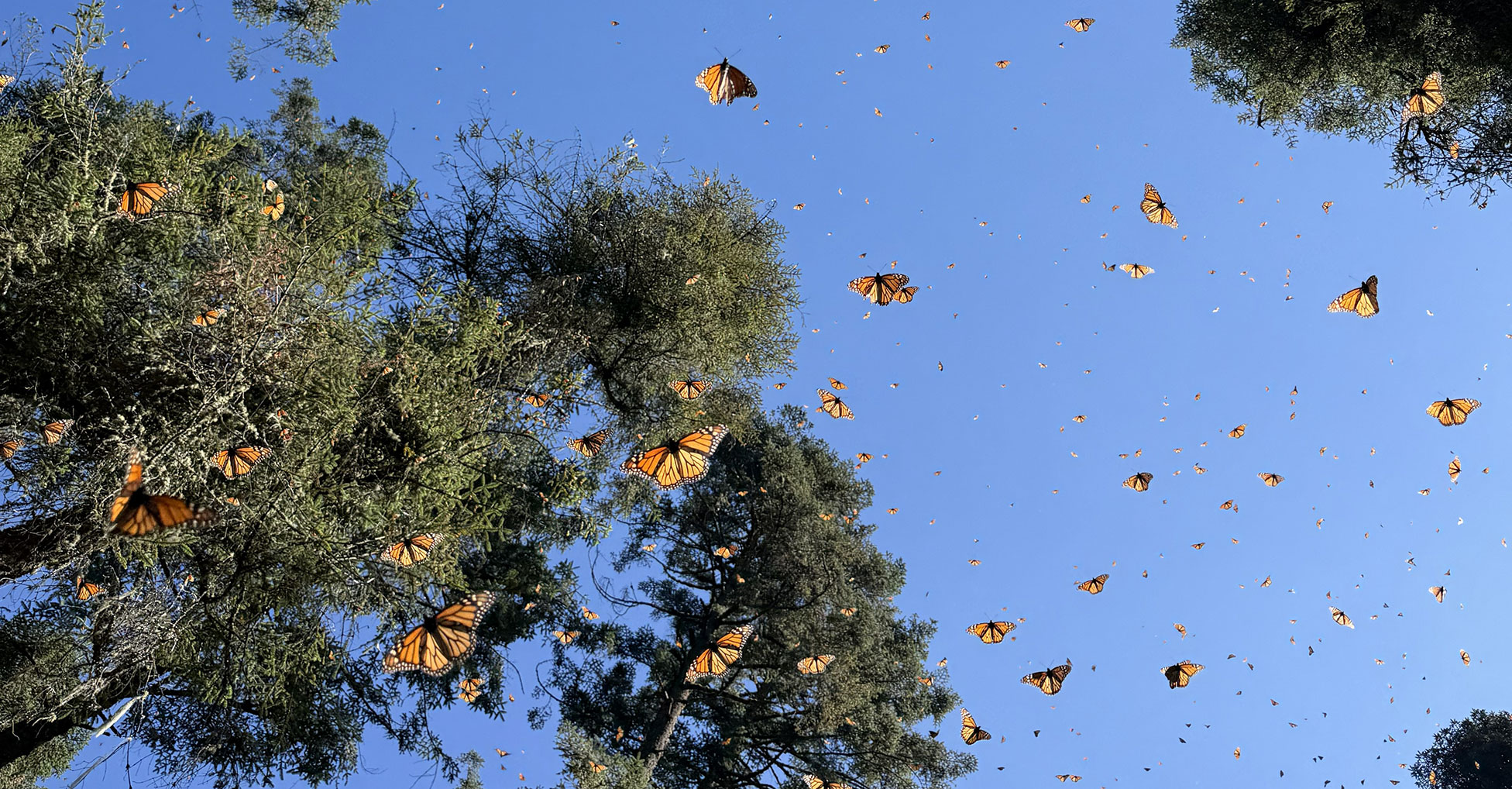
The experience of the monarchs the next day at Sierra del Rosario was simply unbelievable. Once again there was a choice between riding a horse or walking, and I was glad to have taken a horse. The weather was warm and sunny and I couldn’t wait to get into the reserve; a horse was the fastest route! So how was the experience of Rosario? Difficult to put into words but an approximation might be heavenly, ethereal, and sublime. Picture a pine forest with bright sunlight streaming through the trees, creating a patchwork of dappled light. Everywhere you look there are monarch butterflies fluttering around – high up in the canopy, at eye-level, at mid-range, on the ground – they are in every frame. In some areas they are almost swarming around us.
Then in several places we came across them “puddling” – carpeting the ground near a stream or puddle as they drink and rest. Their puddling permitted us to sit on the ground near them at a short distance and just watch them. Was it a few minutes, a quarter hour or longer…I’m not sure? The ability to simply take it all in was perhaps the most exquisite part of this experience. I was not able to hear their wings fluttering as some others with better hearing could, but the ability to simply absorb it all was precious. There is no talking in the reserves, save for some short and whispered communication. We simply walked, sat, and even lay down on the forest floor and stared up at the canopy and the sky as we watched them. We took in the meditative, quiet, full immersion of being with the butterflies and experiencing them with all our senses.
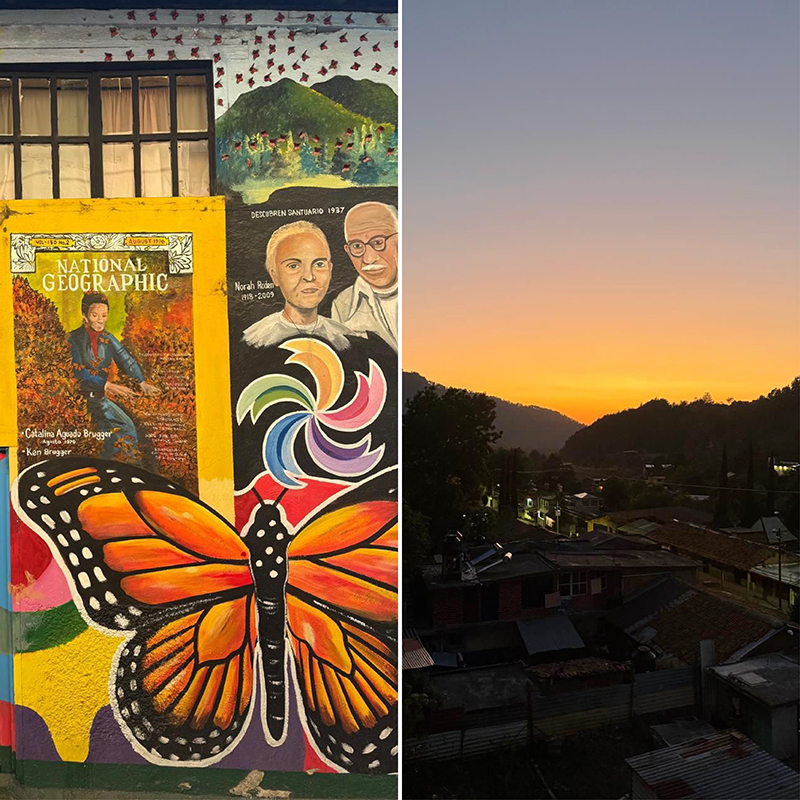
1. Community mural in Angangueo; photo by Arturo Morales 2. Sunset in Angangueo; photo by Arturo Morales
Deep impact traveling with the group
The experience resonated with me in ways I hadn't anticipated. At Holbrook, we strive to create meaningful travel experiences for all our travelers; one lens we use for evaluating that goal is a framework developed by Road Scholar, a lifelong learning and travel organization for which we are a proud program provider. While this Mexico trip was not a Road Scholar program, we use these principals to guide our work everywhere we go. We ask travelers whether they learned something new, stepped outside their comfort zone, changed their perspective on the world, met interesting people, felt welcomed by fellow travelers, felt revitalized, or fulfilled a lifelong dream. These were all true for my journey!
We had such a wonderful group. It was an honor and a privilege to travel with Dr. Kawahara. His knowledge, accessibility, passion, and congeniality lent so much to the experience. Dr. Kawahara’s talks deepened our knowledge about the monarchs and made us feel like part of a scientific expedition. Our local guide, Arturo Morales, was in perfect harmony with us – he understood that we had a deep interest in learning about butterflies, nature, history, culture, archaeology, and more. One of the participants on our trip was Jo Nagai, a Japanese student researcher whose work on generational memory in butterflies garnered international attention. He is 12 years old! Watching his intense interest and passion on the trip added another layer of interest for everyone. (If you are interested in a deeper dive into his story, you can listen to this wonderful podcast.)
The truth is that I met wonderful people and made friends on this trip. I put aside my daily routines and concerns and for this journey, I simply immersed in the wonder of what I was experiencing and enjoyed getting to know new people. I was so revitalized! I thank each and every participant for their enthusiasm and interest in supporting this work and I look forward to doing this again… very soon.
All photos by Andrea Holbrook except where noted
Join the Florida Museum of Natural History on their next monarch migration program, Feb. 7 - 12, 2027. Waitlist only
Join the Florida Museum of Natural History on their next monarch migration program, Feb. 14 - 19, 2027. Learn more